
Project Overview
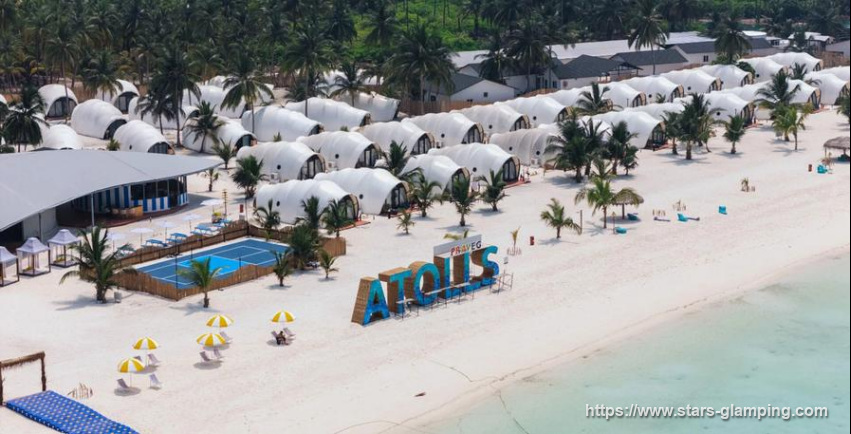
Praveg Atoll’s Lakshadweep sits on Thinnakara Island, a narrow coral atoll in the Lakshadweep archipelago off India’s south-west coast. The resort is built from tented structures rather than solid walls, and its shell-shaped rooms are the work of Stars Glamping: 200 units of the Luxury Tent – Shell, engineered, manufactured and supplied for the project.
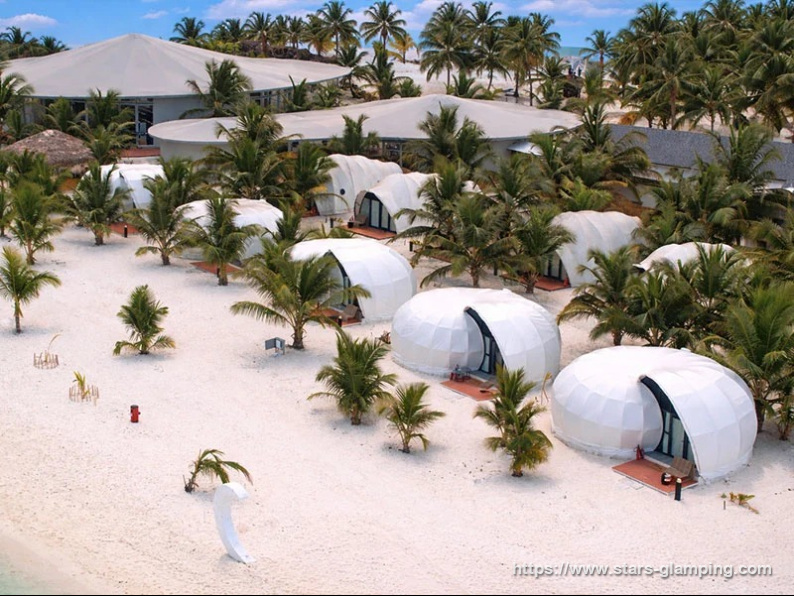
Each shell is a self-contained room with a king bed, a seating corner and its own frontage onto the lagoon. Guests arrive by a short flight to Agatti and then by ferry across the water; from the jetty the shells read as part of the shoreline rather than as buildings placed on it, which is exactly what the brief asked for.
Design Concept
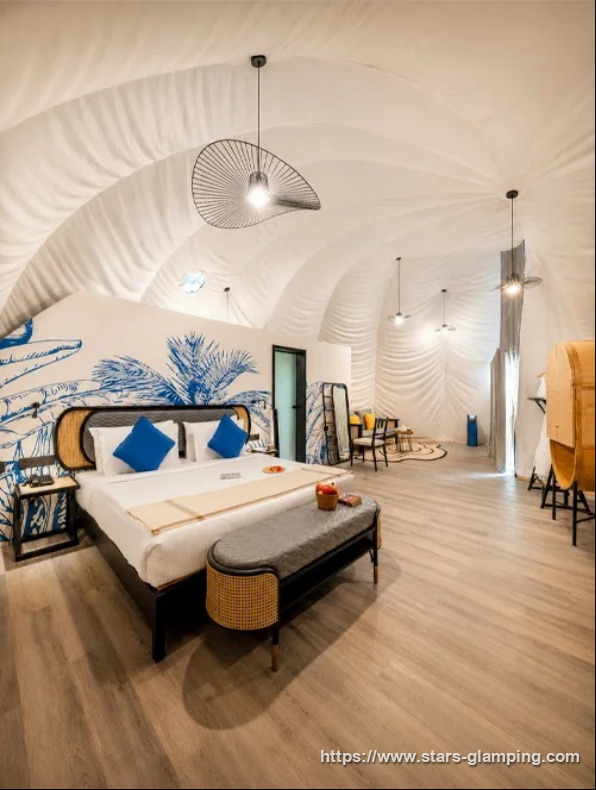
The Shell takes its form from the geometry of a seashell: a curved membrane roof that springs from the ground and folds into a vaulted interior, with no ridge line and no hard edge to break the horizon. In daylight the white surface mirrors the sand; after sunset the vault glows from the pendant lights inside, and the arch becomes the room’s most distinctive piece of furniture.
The vault does the work that walls usually do. Within roughly 56 m² the plan holds a king bed, a seating corner, a wardrobe wall, a minibar and a bathroom, without ever reading as divided — the ceiling simply continues over all of it. Hand-painted palm-leaf murals, rattan screens and light oak flooring keep the palette in the island’s own colours, so the room feels like an interior of Thinnakara rather than a hotel imported onto it.
Each shell sits on its own cleared patch of sand with a deck and outdoor seating. Spacing is generous enough that the palms, not fences, provide the privacy — the resort reads as a grove with rooms in it, not as a row of units.
Built for Salt, Sun and Monsoon
A tent on a coral atoll has to survive a specific set of conditions: salt-laden air that attacks metal, monsoon rain that arrives sideways, and UV that bleaches fabric within a couple of seasons. The Shell is specified for that environment rather than adapted to it afterwards.
The roof is a PVDF architectural membrane, UV-stabilised, waterproof and self-cleaning, so the white stays white through the wet season instead of greying out. The frame is galvanised steel with a powder-coated finish, and fixings are selected for coastal exposure. The curved profile sheds rainwater without ponds forming on the roof, while the liner keeps radiant heat off the interior so air conditioning holds a steady temperature through the middle of the day — a detail that matters when the outside temperature stays above 28 °C for most of the year.
Shipping and Installing 200 Units on a Remote Island
Thinnakara has no factory, no crane and no road. At 15 units that is a logistical detail; at 200 units it becomes the project itself. Every component — frame sections, membrane panels, doors and anchoring hardware — was packed flat for container freight, shipped to the Lakshadweep in successive batches, ferried to the island and assembled on site.
Delivery was sequenced so that erection could follow the ships: each batch arrived complete, frame and membrane and hardware together, so no unit waited on a missing part and no half-built shell sat exposed on the beach. The modular frame goes up by hand, unit by unit, with ground anchors set into the sand instead of concrete foundations, which keeps the build light on a shoreline that has to stay a shoreline.
Two hundred units erected this way is the real argument for a tented resort over a built one at this scale: identical components, identical assembly sequence and an identical finish across the whole estate, at a fraction of the site labour and foundation work. That repeatability is the difference between a showpiece tent and a hotel that can commit to 200 keys.
Beyond the Tent: The Resort Around It
The shell rooms are the seaview tier of a resort built for more than sleeping. Around them sit a restaurant and outdoor bar under a curved canopy, a spa and yoga programme, a beachside pickleball court billed as India’s first, an open-air cinema on the sand, and scuba diving and water sports on the reef. A beachfront conference hall takes up to 500 guests, and wedding setups of the same scale are staged directly on the beach.
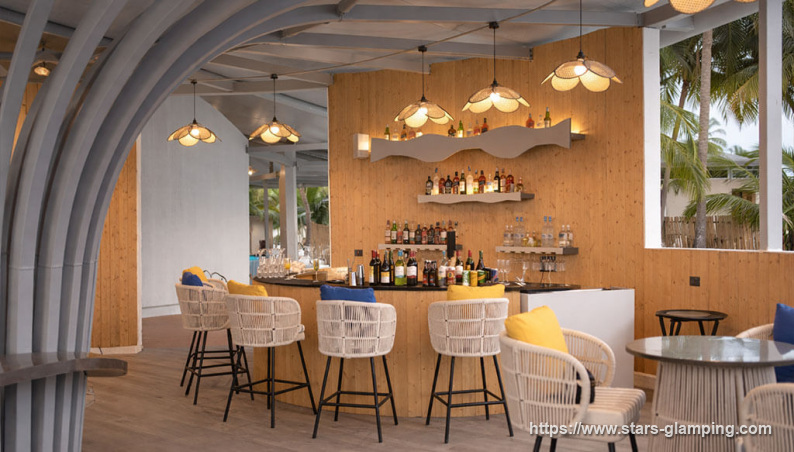
For a resort developer, that mix is the point: the tents are not a standalone attraction but the accommodation layer of a full hospitality operation, and they have to hold their own next to permanent buildings. At 200 units on Thinnakara, they do.
About Stars Glamping
Stars Glamping is a luxury tent manufacturer and supplier based in Guangzhou, China, specialising in glamping tents, dome houses and tent villas for resorts, campsites and hospitality projects worldwide. Our tent factory delivers full-scope solutions — design, engineering, production, shipping and on-site installation guidance — with every project customised to its climate, its site and its guest profile.